





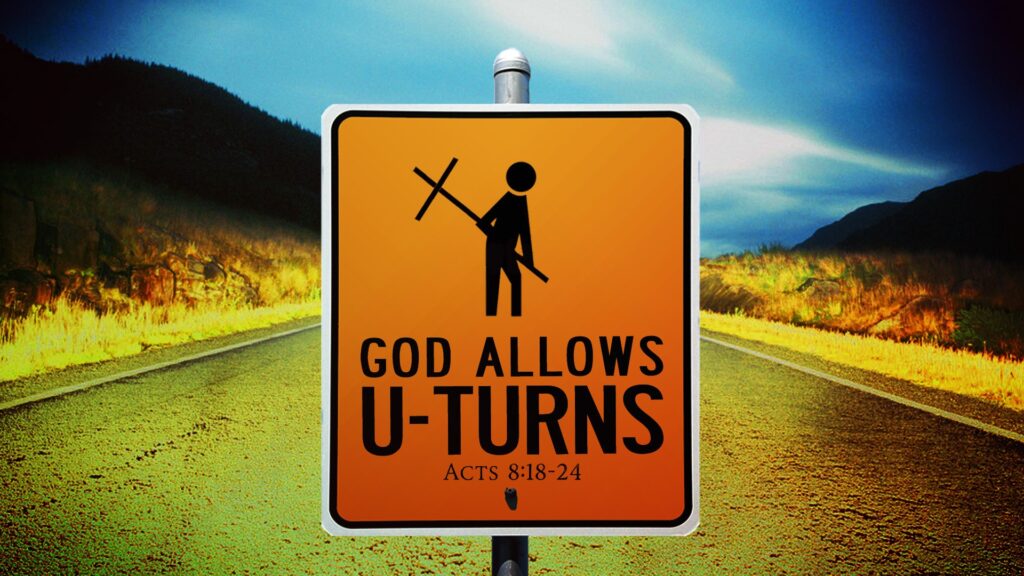
God Allows U-Turns (Acts 8:18-24)
When I was about five, Mom and Dad loaded all of us in the car to spend a week with my grandparents in Indiana. About an hour into the trip, something clicked; Mom looked at Dad and said, “Randy, did you get the luggage?” Dad said, “Cathy, I thought you got it.” Our luggage was still sitting in our family room, so we went back home before going to Mammaw and Papaw’s.
Have you ever needed to turn around? Did you ever forget your wallet? Did you ever get so lost that you didn’t know where you were? How many of you have walked out of Walmart and couldn’t find your car? Did you ever lose the remote control?
We get lost and need to turn around. When we lose our way spiritually, God allows us to come back home where he will welcome us. Yet, to be welcomed home, “A Christian must repent of his sins.”
Scripture (Acts 8:18-24)
verses 18-19:
Simon, a magician, had “amazed the people of Samaria” (Acts 8:9). When he realized Peter and John could do something he couldn’t, he offered them money so he could have the same ability.
Some think Simon couldn’t have fallen if he were a true Christian. However, the Samaritans believed and were baptized (Acts 8:12). Simon also believed and was baptized (Acts 8:13). Simon did the same thing everyone else in Samaria did; if Simon weren’t a real Christian, neither were the rest of the Samaritans!
verses 20-21:
“Perish” means to be eternally condemned in this context. Simon had neither “part nor lot in this matter.” Simon had no part in the authority of the Holy Spirit, and he had no lot in the apostolic ministry.
verses 22-23:
Simon needed to repent of his wickedness. In Greek, the tense of the word “repent” means Simon needed to act immediately.
Simon also needed to “pray to the Lord that, if possible, the intent of [his] heart may be forgiven.” “Intent” can, in Greek, mean evil or hostile schemes. “May be forgiven” is in the passive voice and emphasizes God would do the forgiving.
Peter could see that Simon was “in the gall of bitterness and in the bond of iniquity.” Gall means bile, that bitter fluid secreted by the liver; being “in the gall of bitterness” means full of bitter poison. “In the bond of iniquity” conveys that Simon was being held in sin’s grasp.
Application
Because he fell into sin, Simon needed to repent and to pray. “A Christian must repent of his sins.” You sin: “If we say we have no sin, we deceive ourselves” (1 Jn 1:8). You should pray when you sin: “Confess your sins to one another and pray for one another” (Js 5:16).
What does repenting of your sins mean for you? Simon’s case explains.
One: Simon’s Sin
Simon sinned. You sin. “Surely there is not a righteous man on earth who does good and never sins” (Eccl 7:20). “If anyone sees his brother committing a sin. . . .” (1 Jn 5:16). Paul said of himself: “I do not do the good I want, but the evil I do not want is what I keep on doing” (Rom 7:19); if an apostle sinned, do you think you will escape sin?
Simon sinned; Simon knew how he sinned; only because Simon knew how he sinned could he repent of that sin. Take a hard look at your life. What sin is there? Where have you lacked repentance? Know your sin.
Two: Simon’s Separation
Simon was separated from God; Peter told him, “Your heart is not right before God.” Your sin separates you from God, too. “If I had cherished iniquity in my heart, the Lord would not have listened” (Ps 66:18). “You have hidden your face from us, and have made us melt in the hand of our iniquities” (Is 64:7).
Sin’s separation brings serious consequences. God will not hear your prayers. God will not forgive your sins. God will not comfort you. God will not spiritually bless you. And the wicked “will suffer the punishment of eternal destruction, away from the presence of the Lord and from the glory of his might” (2 Thess 1:9).
Do you want to stand separated from God? If not, repent.
Three: Simon’s Summons
Peter summoned Simon, i.e., he confronted him. After Adam sinned, God summoned him: “Who told you that you were naked? Have you eaten of the tree of which I commanded you not to eat?” (Gen 3:11). When Herod married his brother’s wife, John the Baptizer confronted him (Matt 14:3-4). When Peter acted hypocritically, Paul confronted him (Gal 2:11-14). Scripture summons you with your sin: Hebrews 4:12-13.
Because of Simon’s Summons, you must act three ways:
- Confront Christians when they sin.
- Accept correction when you sin.
- Study Scripture and be confronted with your sin.
Four: Simon’s Supplication
Simon needed supplication—prayer. David prayed for forgiveness: “Hide your face from my sins, and blot out all my iniquities” (Ps 51:9). You’re to confess your sin: “If we confess our sins, he is faithful and just to forgive us our sins and to cleanse us from all unrighteousness” (1 Jn 1:9).
Do you understand why praying for God’s forgiveness works so well? Because God answers prayer! “Confess your sins to one another and pray for one another, that you may be healed. The prayer of a righteous person has great power as it is working” (Js 5:16). In the very same verse where the Spirit instructs Christians to confess their sins, he says that prayer has great power!
When is the last time you supplicated before God for your forgiveness? Do you need to confess your sins this morning? Do you need to ask us to pray for you this morning?
This sermon was originally preached by Dr. Justin Imel, Sr., at Church of Christ Deer Park in Deer Park, Texas.